Curriculum
We offer a variety of educational activities in order to reach everyone’s learning style. This includes morning report, bed side rounds, didactics, grand rounds, web-based modules, simulation training and home study opportunities.
Morning/Afternoon Report is a crucial component of resident education and provides a valuable opportunity to develop clinical reasoning, diagnostic skills and evidence-based decision-making. To maximize this opportunity, it is important that the Report is robust, interactive and learner-centered. Our Morning/Afternoon Report format is designed to promote active participation from residents while also ensuring that the night-float team can participate each week in this important educational activity.
Morning/Afternoon Report is held:
- Monday and Tuesday from 7:30-8 a.m.
- Thursday and Friday from 12:45-1:15 p.m.
The Friday report is an evidence-based report in which the presenting teams discuss evidence to answer a clinical question about one of their cases.
Goals
- Identify and communicate key clinical information from the history and physical examination to develop an evidence-based differential diagnosis.
- Apply hypothesis-driven clinical reasoning by asking focused questions and using information from the history and physical examination to refine the differential diagnosis.
- Accurately interpret laboratory and imaging findings, with an emphasis on clinical relevance and high-value care.
- Synthesize clinical information to arrive at a working or definitive diagnosis, when possible.
- Develop an appropriate diagnostic and treatment approach based on the available clinical information and current evidence.
- Reinforce learning through evidence-based resources, including a recent article, guideline, podcast or other relevant educational resource.
- Promote collaborative learning and teaching.
Our didactic curriculum is based on the high-yield American Board of Internal Medicine certification blueprints and delivered by Internal Medicine and Subspecialty faculty. Noon Didactics include, but are not limited to, specialty-based topics, journal club, quality improvement patient safety lecture, pharmacy lectures and Grand Rounds.
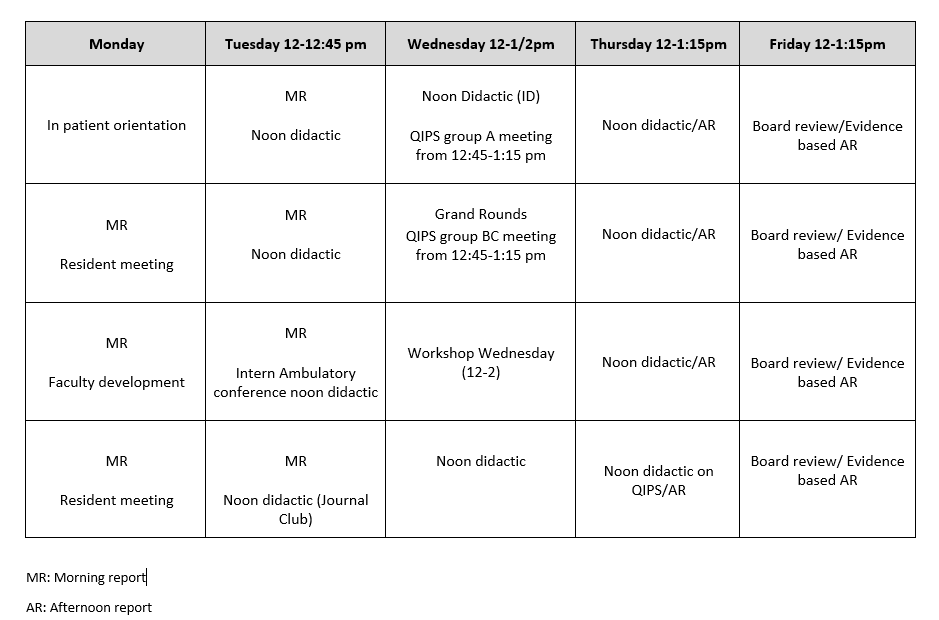
Our residency program has a robust Quality Improvement and Patient Safety program. The program involves a mix of didactics including introducing the key concepts of quality improvement and patient safety such as QI methodology, change management and Just culture etc.
The residents apply this learning to the ongoing QI projects and work step by step through the DMAIC methodology with support from a designated faculty member.
Our current QI projects are focused on providing efficient, high quality and evidence-based care to our patients as well as trying to address healthcare disparities. Some of the ongoing residents’ projects are as follows:
- Improving the accurate code status documentation in patients with stroke, CHF, and COPD.
- Increasing the number of patients with the AMD in the resident clinic.
- Increasing the compliance of CHF discharge bundle in the patients admitted to the resident service.
In addition to this, residents are given opportunities to participate in different hospital committees working on various QI projects on a system wide level.
Sample Block Schedule Diagram (will vary year to year according to complement)
Behavioral Medicine, Cardiology, Endocrine, Emergency Medicine, Gastroenterology, Geriatrics, Hematology-Oncology, Infectious Disease, Nephrology, Neurology, Palliative Care, Pulmonology, Rheumatology
- Allergy/Immunology
- Anesthesia
- Away rotation
- Cardiac ICU
- Clinician-educator track
- Community outreach
- Dermatology
- Hospitalist
- Interventional radiology
- Obesity medicine
- Outpatient procedures
- Physical medicine and rehabilitation
- Point-of-care ultrasound
- Research
- Women's health
We have monthly grand rounds with CME which focus on subspecialty topics as well as DEI related topics for interdisciplinary learning.
Our residents participate in monthly hands-on workshops at the CAMC Center for Learning and Research, providing a structured, immersive environment to develop and refine essential procedural and clinical skills. These workshops emphasize experiential, hands-on learning and allow residents to build confidence and competence in a supportive setting with faculty guidance. Our curriculum includes ICU-focused procedural workshops where residents gain experience with paracentesis, thoracentesis, arterial line placement, and intubation.
Additional workshops cover a broad range of skills essential to internal medicine practice, including joint injections, point-of-care ultrasound (POCUS), skin biopsies, musculoskeletal examination and women’s health, among others. By incorporating regular simulation and hands-on experiences throughout residency, we aim to ensure that residents graduate with not only strong clinical knowledge but also the practical skills, confidence and competence needed to provide high-quality patient care.
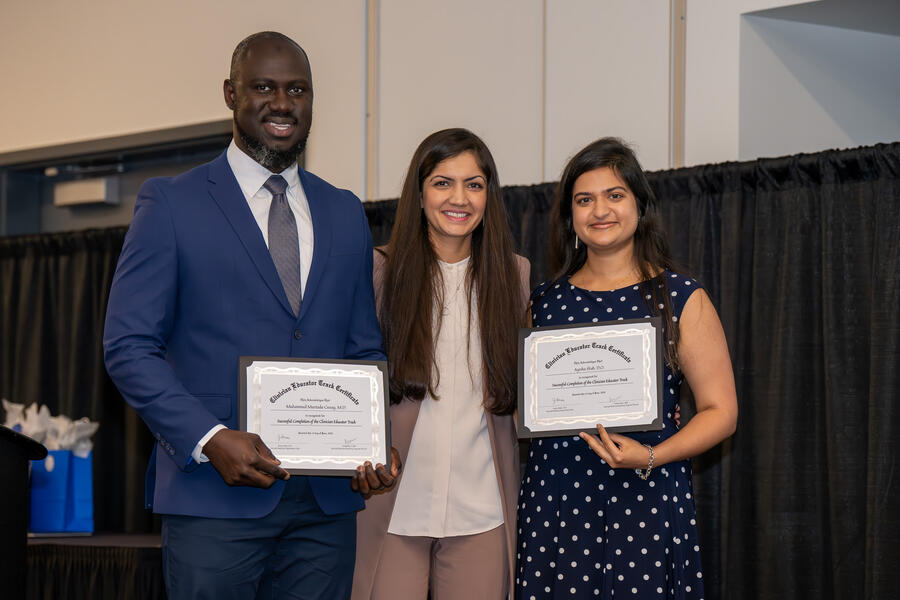
The Clinician Educator Track (CET) is designed for internal medicine residents with a passion for teaching and a career interest in medical education. Our goal is to prepare residents to become skilled clinician-educators, thoughtful leaders and innovators in medical education. Through longitudinal mentorship, experiential learning and focused educational sessions, residents develop the knowledge and skills needed to excel as educators throughout their careers. Participants strengthen their clinical teaching skills, learn to design and implement innovative curricula and develop effective strategies for providing meaningful feedback to both learners and programs
The track also introduces residents to the skills needed to become effective administrators, leaders and change agents, while providing opportunities to explore educational scholarship, investigate important questions in medical education and disseminate scholarly work. Whether pursuing a career in academic medicine or incorporating education into clinical practice, the CET provides residents with a strong foundation to teach with purpose, lead with confidence and contribute meaningfully to the future of medical education.
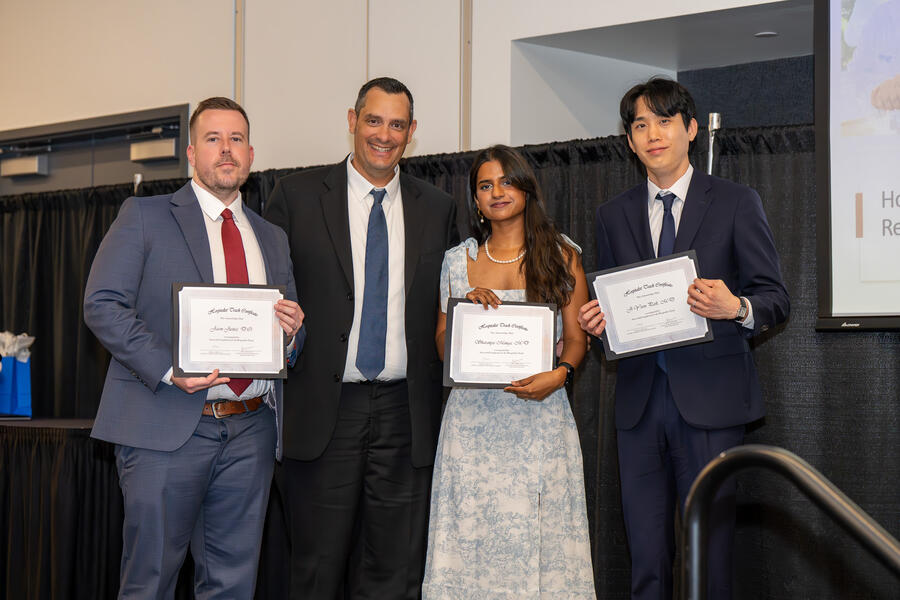
The primary aim of the Hospitalist Track is to provide additional clinical and educational training and mentorship to internal medicine residents who are interested in a Hospital Medicine career.
The objectives for track participants are to:
- Rotate through clinical experiences designed to help prepare residents for Hospital Medicine careers such as Point of Care Ultrasound (POCUS)
- Design and implement inpatient quality improvement projects
- Participate in a didactic curriculum focused on topics and metrics specific to Hospital Medicine
- Develop leadership and teamwork skills by participating in hospital committees
- Receive dedicated mentorship from experienced Hospitalists
The Internal Medicine Primary Care Track is designed for residents pursuing careers as thoughtful, skilled and versatile general internists. This track offers robust training across diverse clinical environments, preparing residents to deliver comprehensive, patient-centered care while fostering strong longitudinal relationships.
Residents in the primary care track gain exposure to private practice and rural primary care settings, providing valuable insight into a variety of practice models, patient populations and health care delivery systems. These experiences emphasize ambulatory excellence, care coordination and population health, while highlighting the unique rewards and challenges of primary care in both community-based and rural environments.
Opportunities unique to the primary care track include a dedicated private practice rotation with exposure to the business of medicine, outpatient procedures elective focused on the performance of joint injections, sports medicine exposure incorporating ultrasound evaluation and procedural guidance, an enhanced continuity clinic experience with dedicated outpatient faculty mentorship and access to one on one point of care ultrasound education to enhance bedside decision-making in ambulatory and inpatient care. Primary care track residents are encouraged to engage in research or quality improvement projects that improve clinical outcomes, advance health systems innovation and promote patient-centered care — developing skills essential for leadership and lifelong learning in primary care.
Please reach out to the primary care track director, Caleb Martin, DO, at Caleb.Martin@vandaliahealth.org with any questions.
Research and Simulation Learning
CAMC and the Department of Internal Medicine are committed to providing the necessary support for each of our learner's research needs. Whether your focus is in case presentation or original research, we have the tools in place to assist you through your project.
Suzanne Kemper, MPH, provides research support for the CAMC Department of Internal Medicine. Her role includes protocol development, IRB submissions/amendments, data collection design, analysis/results reporting, editing poster/presentations and manuscript development/submission.
Research focus areas include, but are not limited to, opioid use, liver cirrhosis, hepatitis A, gun ownership, heart failure and lung cancer screening. Abstract assistance for presentations/posters include CAMC Research Day (11 case/original posters/oral), WV State ACP (25 case/original posters, 2 orals) and National Conferences (19 case/original posters/oral presentations). Suzanne provides support on grant funded projects, including an American Cancer Society project related to lung cancer screening. She also guides and mentors Everest Institute candidates, as well as Summer Externs, during their time on campus. IM QIPs projects will become a vital part in how quality research can translate to practice. The reporting of IM Research is maintained via New Innovations.
Learn more about Research at CAMC
Simulation Center
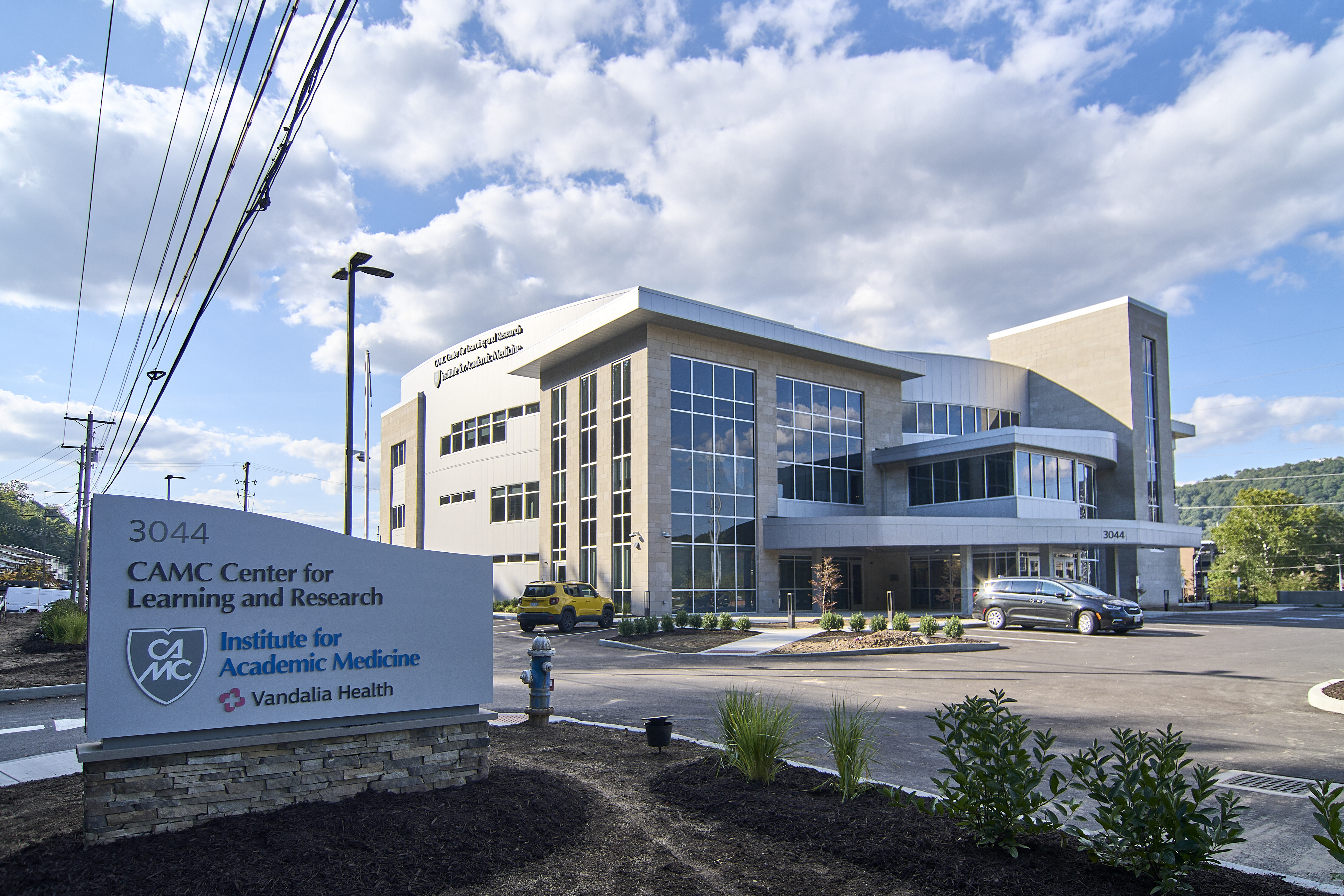
The CAMC Center for Learning and Research maintains a full-time staff, including a curriculum development specialist who will assist faculty members with integrating simulation into their curricula. Simulation technology has advanced in recent years to allow for high-fidelity experiences that, when used as part of a larger educational experience, can greatly enhance medical education.
The Internal Medicine department utilizes the Center for Learning and Research for the following:
- Videoed Standardized patient for all interns
- Procedural Simulation
- Ultrasound assisted Central Lines
- Paracentesis
- Thoracentesis
- Lumbar Puncture
- Peripheral IV
- Venipuncture
- Pap exams
- Patient Simulation in following scenarios:
- Obtaining code status
- Breaking bad news
- Obtaining consent